
The applications of hand engraving.
First of all, engraving should not be confused with chiselling, the former consisting in hollowing out the metal using tools or acid, the latter in deforming it by hammering, using chisels of various shapes.
There are many different engraving techniques, depending on the desired result.
These different aspects of engraving are interrelated and use techniques that are sometimes similar, requiring precision, rigour and creativity.
The engraver’s hand must master its tools and reproduce the subject in minute detail, which may be a monogram, a coat of arms, a text in a particular alphabet, a symbol, an ornamental motif, etc.
Meticulous preparatory drawings are necessary, to place all the details, shadows and light that, optically, will give the illusion of volume to the chosen subject. These drawings allow any fine-tuning to take place before the engraving itself.
ENGRAVING AND STATIONERY
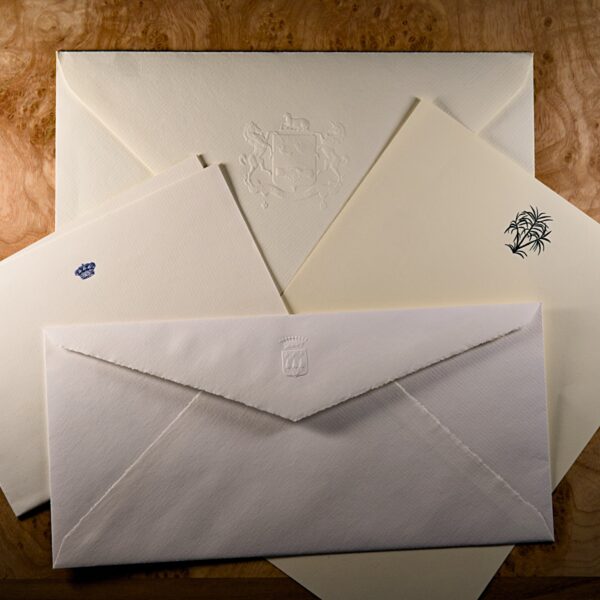
The general principle of engraving for printing is to hollow out the metal, reproducing the chosen motif or text.
Engraving is carried out upside down, with printing turning it right side up. Once the engraving has been completed, the surface of the metal is inked, then the excess is wiped off. Only the fine grooves retain the necessary ink, which is applied to the paper under the pressure of the cylinder or press.
- If the motif is debossed: the printing ink will be slightly raised (for example on a business card).
- If the motif is engraved in relief: the printing will be slightly recessed (or gold leaf in the case of a gilding iron on leather).
For engravings related to personalised stationery and books, the materials used are copper, wood (more specifically for ex libris), steel or bronze, which are used to make prints, gilding tools, blocks for stamping letterhead, plates for business cards, invitations or ex libris…
The different techniques used for stationery :
Intaglio” engraving : This is done with a burin on thin copper plates.
Etching: Another method involves etching the varnished surface with acid. The motif to be reproduced is then traced with a point, scratching the varnish and exposing the metal in the desired places. Successive acid bites are then applied until the desired effect is achieved.
Engraving “en timbrage”: this is done on steel and is specially adapted to paper for correspondence, whether for a simple address, a coat of arms or a specially created monogram. It is possible to print in several colours, superimposing them exactly. In this case, you need to engrave one block for each colour, and an additional block for the final embossing, which will give the overall effect its full relief, highlighting the finest details.
Relief” engraving: used to engrave gilding irons for art bookbinding, heat-fixing gold leaf onto the leather to reproduce the delicate contours of coats of arms, decorative fleurons or elegant monograms…
For engravings related to personalised stationery and books, the materials used are :
- Copper
- wood (more specifically for ex libris)
- Steel or bronze are used to make prints, gilding tools, blocks for stamping letterhead, plates for business cards, invitations or ex libris…
JEWELLERY ENGRAVING
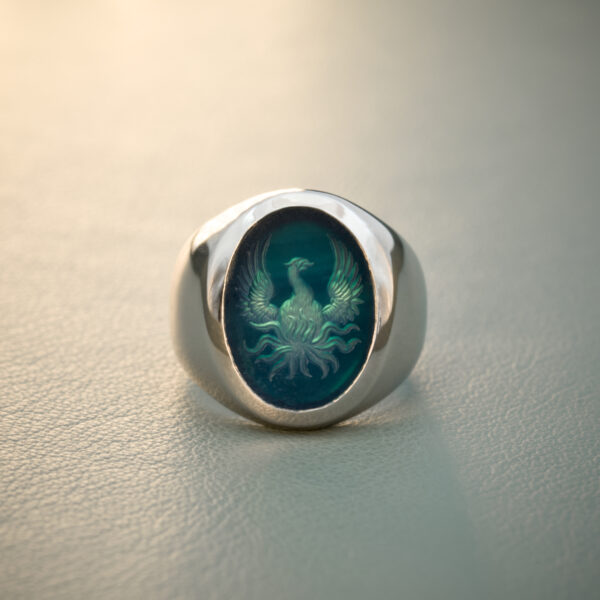
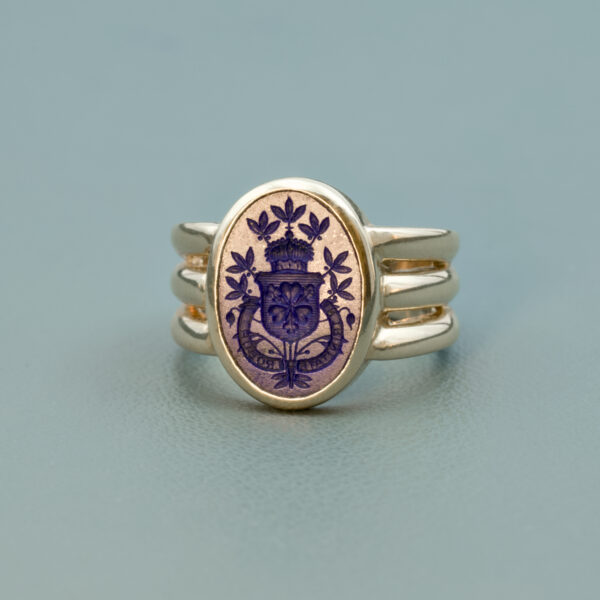
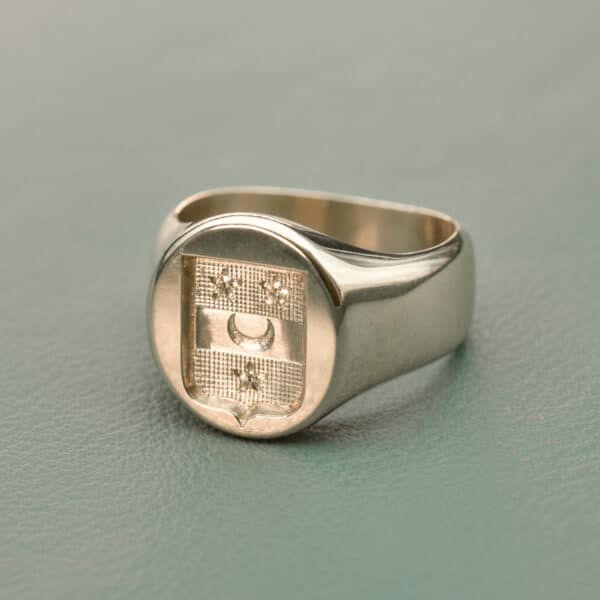
Engraving also has a valuable application in jewellery.
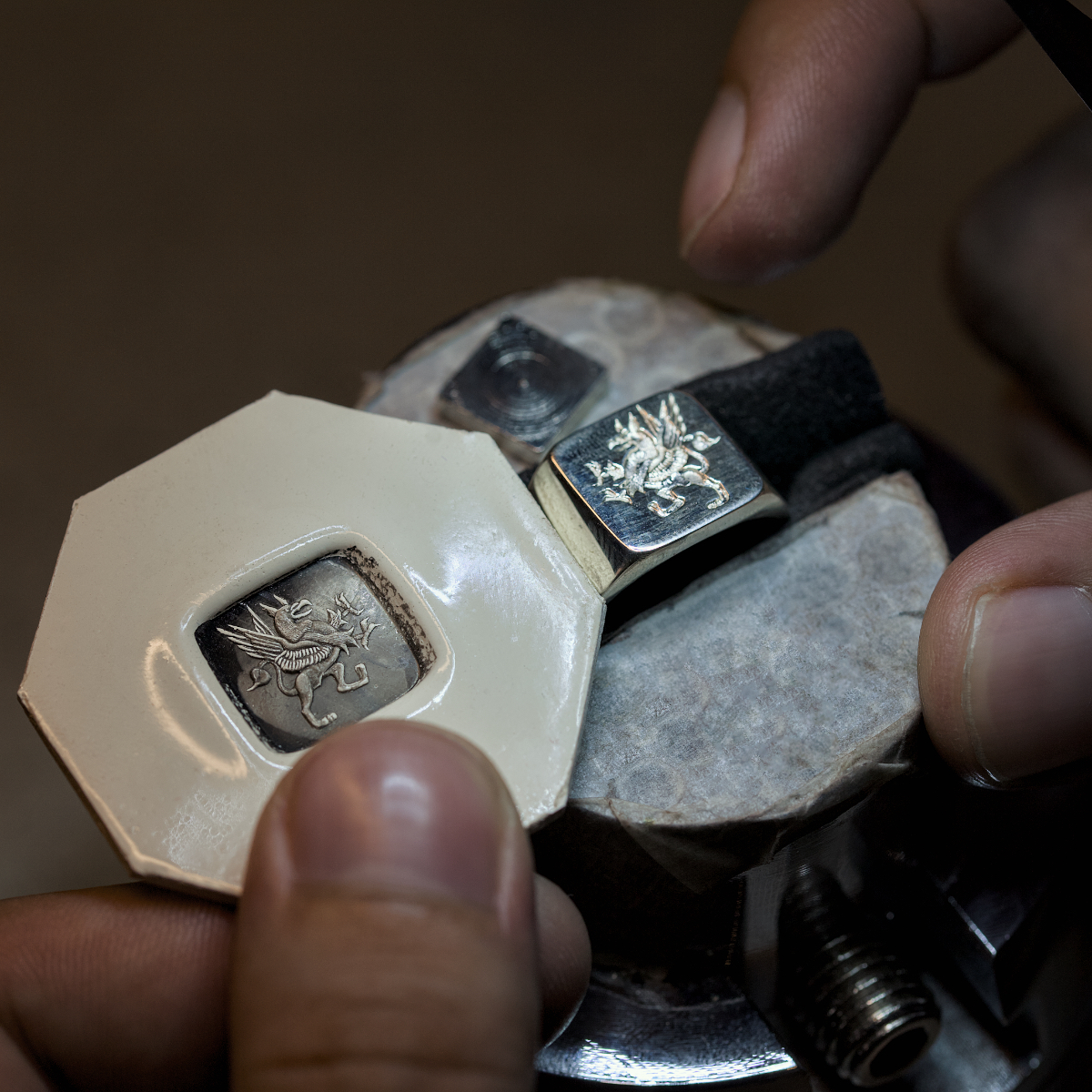
Signet rings, for example, can be personalised with coats of arms, monograms or other symbols, engraved upside down to respect their original function: a signet ring is first and foremost a seal.
Engraving can be carried out on yellow, pink or white gold, platinum or silver, or on precious, semi-precious or hard stones, offering a wide range of effects, from the most discreet to the most spectacular.
Engraving precious metals
Gold, platinum and silver are engraved by successively removing metal shavings using scythes and chisels, a long and meticulous process.
Certain repetitive elements common in heraldry, such as stars, crescents, ermine spots and fleurs-de-lys, are struck using hardened steel punches that the engraver has engraved in relief.
Stone engraving
Heraldic engraving on stone is done by hand, by carefully abrading the stone with tiny milling cutters.
After engraving, the resulting wax impression is highly detailed, like a miniature bas-relief.
Christening medals, wedding rings and other items of jewellery can also be engraved on request with names, dates, initials or dedications…
ORNAMENTAL ENGRAVING
Ornamental engraving, particularly on goldsmiths’ and silversmiths’ wares, is done with a burin, but this time on the right side, since the motif must be seen and not printed. This is known as “reading” engraving. The engraver is faced with an additional difficulty, that of the curvature of the objects.
Hand engraving allows the concave or convex curves of goldsmith’s and silversmith’s pieces to be followed.
Personalising pieces of silver by decorating them with coats of arms, monograms with or without crowns, decorative, floral, plant or animal motifs, etc. gives them a unique character.
Here again, preliminary drawings meeting the customer’s requirements are essential, in a style that must be in harmony with that of the object, helping to determine the location of the motif.
Hunting trophies, paintings and collectors’ items are also accompanied by customised engraved cartouches.
So many other ideas, yet to be found, can be enhanced and made more beautiful by one or other of the techniques presented above, using the multifaceted art of engraving, which is thousands of years old and still contemporary.
